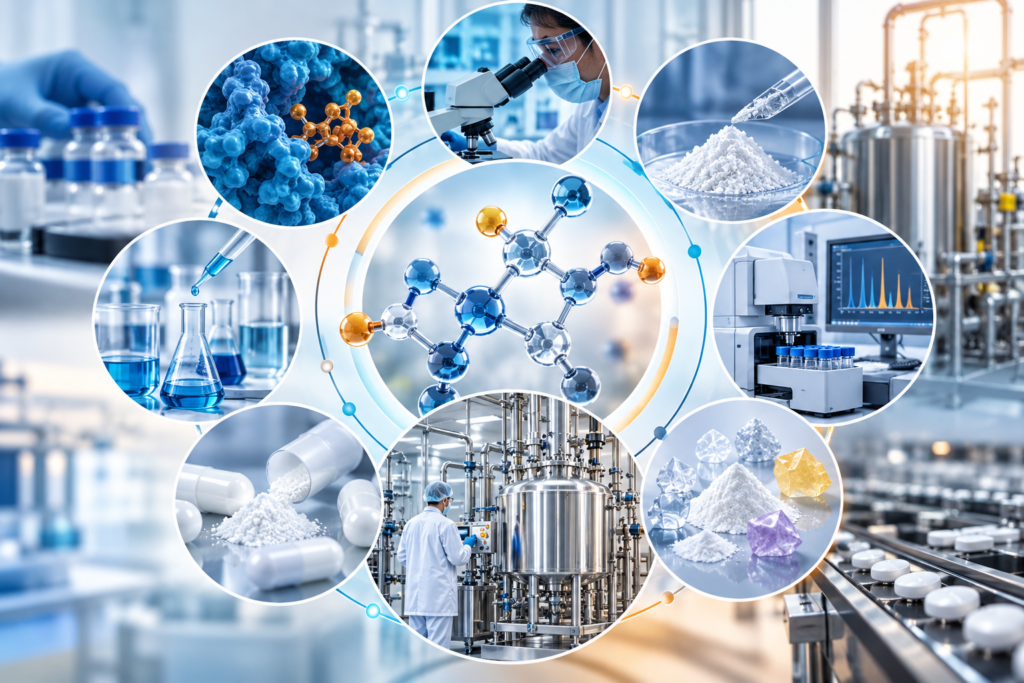
Not every active pharmaceutical ingredient (API) can be treated like a conventional manufacturing project. Some drug substances are highly potent, while others contain complicated molecular structures, multiple stereocenters, sensitive functional groups, or challenging impurities. Certain APIs also require extremely tight control over particle characteristics, solid forms, moisture, temperature, or containment. These molecules fall into a category where conventional manufacturing approaches may not be sufficient.
The challenge is not simply making the API. It is developing a process that can reliably control the molecule’s chemistry, physical properties, impurities, safety requirements, and scalability at the same time. This requires specialized expertise in API development, process optimization, analytical testing, and pharmaceutical manufacturing.
There is no single characteristic that defines every specialty API. A drug substance may be considered technically challenging because of its high potency, complex molecular structure, multiple stereocenters, low stability, difficult purification, narrow process window, sensitive solid state, complex impurity profile, specialized containment requirements, or limited manufacturing experience. In some cases, several of these challenges occur simultaneously, making process development substantially more demanding than conventional small molecule API manufacturing.
Highly potent compounds can produce significant biological effects at very low concentrations, creating additional requirements for occupational safety and contamination control. Manufacturing environments may therefore require carefully designed containment strategies covering material transfer, equipment selection, cleaning procedures, personnel protection, waste handling, environmental controls, and cross contamination prevention.
The manufacturing objective is twofold: protecting the product from contamination while also protecting personnel and the surrounding environment from exposure. For particularly potent compounds, containment becomes a fundamental part of process design rather than an operational detail added later. Appropriate containment measures are essential for safe, consistent, and reliable pharmaceutical manufacturing.
A simple molecular structure does not necessarily mean a simple process. However, increasing structural complexity often introduces additional development challenges. A molecule containing multiple stereocenters, fragile functional groups, or several chemically distinct regions may require carefully controlled reaction conditions.
Researchers may need to consider chemoselectivity, regioselectivity, stereoselectivity, reaction compatibility, intermediate stability, protection and deprotection strategies, and impurity control. Small changes in reaction conditions can sometimes produce significant differences in the resulting impurity profile. Therefore, effective API process development requires a detailed understanding of how the chemistry behaves under different conditions to achieve consistent product quality and reproducible manufacturing outcomes.
Producing the desired molecule is only part of the problem. The product must also be separated from unwanted substances generated during synthesis. This becomes especially challenging when impurities have chemical properties similar to the API, making their removal more difficult.
The development team may need to evaluate crystallization, precipitation, filtration, extraction, distillation, adsorption, and chromatographic purification. The preferred approach is generally one that provides effective impurity removal while remaining practical at manufacturing scale. A purification strategy that works perfectly for a few grams may become expensive, inefficient, or difficult to control when hundreds of kilograms are involved. For this reason, purification methods must be evaluated for efficiency, scalability, cost, and their ability to consistently meet the required quality specifications.
Specialty APIs can generate complicated analytical profiles. A batch may need to be evaluated for numerous potential impurities, degradation products, stereoisomers, residual solvents, elemental impurities, or other process related substances. As a result, analytical development becomes closely connected with process development.
If an unexpected impurity appears during scale up, analytical scientists need to determine what it is, where it came from, whether it is adequately controlled, and whether changes to the process are necessary. This is why robust analytical methods are essential for complex drug substance development. Reliable analytical testing supports impurity identification, quality control, process optimization, and consistent API manufacturing.
The chemical identity of an API is not the only factor that matters. The same active pharmaceutical ingredient can sometimes exist in different physical forms, including different polymorphs, solvates, or hydrates. These forms can differ in properties such as solubility, dissolution, stability, melting behavior, density, and flow properties.
For a finished pharmaceutical product, these differences may influence formulation performance. Therefore, solid state characterization is an important consideration for many specialty APIs, particularly when physical form can affect product quality. Understanding these properties early in development helps manufacturers select and control the appropriate solid form for reliable pharmaceutical production.
One of the most important moments in API development occurs when a process moves beyond laboratory scale. Heat transfer and mixing characteristics change, addition times become longer, mass transfer can behave differently, and crystallization may produce different particle characteristics. Consequently, a reaction that appears straightforward in a small vessel may behave differently in a larger manufacturing environment.
This is why API scale up requires more than simply increasing the quantity of every material. Process parameters need to be understood well enough to predict how the chemistry will respond to larger equipment and different operating conditions. Careful process optimization and scale up studies help identify potential challenges, improve reproducibility, and establish reliable manufacturing procedures.
Some specialty APIs are particularly sensitive to environmental conditions. Temperature, humidity, oxygen, light, or mechanical stress may contribute to degradation or physical changes. Stability studies help determine how the drug substance behaves over time and under different storage conditions.
The resulting information can influence packaging selection, storage conditions, retest periods, transportation requirements, manufacturing controls, and finished product development. For molecules with limited stability, these considerations may need to be incorporated early in development rather than addressed after manufacturing has been established. A well planned stability strategy helps maintain API quality throughout storage, transportation, and subsequent pharmaceutical production.
Technical complexity naturally affects manufacturing economics. A specialty API may require expensive raw materials, specialized equipment, additional analytical testing, lower production throughput, or more complex purification. However, cost should not be evaluated only on the basis of the price per kilogram.
A process with a slightly higher direct manufacturing cost may ultimately be more valuable if it provides better batch consistency, higher yield, lower waste, improved impurity control, greater manufacturing safety, easier scale up, and more reliable supply. The real objective is to establish a process that remains technically and economically sustainable as demand increases. Evaluating these factors together helps pharmaceutical companies make better decisions about API development, manufacturing investments, and long term supply reliability.
Specialty APIs demonstrate why drug substance development cannot always follow a standard template. Instead, the development strategy must be adapted to the characteristics of the molecule. For one compound, the central challenge may be containment. For another, it may be stereochemical purity. A third may be dominated by crystallization or stability issues.
This makes multidisciplinary expertise particularly valuable. Chemists, analytical scientists, engineers, quality professionals, regulatory specialists, and manufacturing teams may all contribute to solving different parts of the same API development problem. Collaboration between these teams helps connect laboratory findings with practical manufacturing requirements and supports a smoother transition from development to commercial production.
The strongest manufacturing strategies typically bring together several capabilities rather than treating each challenge separately. These capabilities include process development, which establishes a practical and reproducible synthetic route; analytical development, which builds methods capable of detecting and controlling relevant impurities; and scale up, which translates laboratory chemistry into reliable manufacturing operations.
Other important capabilities include containment, which manages exposure risks associated with potent compounds; solid state characterization, which identifies physical forms that may influence product performance; quality control, which maintains consistent specifications and batch quality; and technology transfer, which moves a well understood process between development and manufacturing environments. Integrating these capabilities helps pharmaceutical companies address technical challenges while maintaining product quality, process efficiency, and manufacturing consistency.
As pharmaceutical research expands into increasingly sophisticated therapies, drug substance development is also becoming more technically demanding. New molecules may require tighter impurity control, advanced analytical technologies, highly specialized manufacturing environments, or more sophisticated containment systems. The industry is therefore moving toward development strategies built around deeper process understanding rather than simply reproducing a laboratory synthesis at larger scale.
For specialty APIs, the ability to understand why a process works, identify where it can fail, and design controls around those risks can be just as important as the chemistry itself. Ultimately, successful specialty API manufacturing is about turning molecular complexity into a process that is controlled, reproducible, scalable, and suitable for pharmaceutical production.
For organizations working with technically challenging drug substances, exploring specialized API development and manufacturing capabilities can help identify the expertise, infrastructure, and quality systems required to move complex molecules toward reliable production. By evaluating these capabilities early, pharmaceutical companies can make more informed decisions, manage development risks, and establish a stronger foundation for consistent, high quality API manufacturing.

IntroductionIn the competitive world of pharmaceutical ingredients, effective API sales and marketing strategies are crucial for standing out. It’s not just about showcasing products—it’s about building relationships, trust, and visibility... Read more

Executive Summary Third‑party Good Manufacturing Practice (GMP) audits are independent assessments conducted by external experts to verify that pharmaceutical and biotech organizations—and their suppliers—operate in compliance with applicable regulations and... Read more

Pharmaceutical drugs must maintain their potency, safety, and effectiveness throughout their shelf life. Analytical development plays a critical role in assessing and ensuring drug formulation stability. Importance of Analytical Development... Read more

